National Museum of Bermuda (NMB)
National Museum of Bermuda (NMB, previously the Bermuda Maritime Museum) is a museum dedicated to the 500-year old island history of development, and culture of Bermuda. The museum was awarded more than 10 times, and it is monthly visited by more than 10,000 tourists.
History of the museum
NBM is a non-profit, non-governmental, and charitable organization, which was founded and registered based on the National Fund of Bermuda in 1974. The original name of the museum is the Bermuda Maritime Museum.
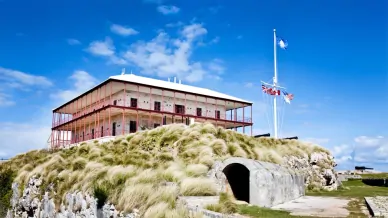
Exterier of NMB
Thought, the official opening of the institution took place in 1978. The National Museum of Bermuda has been receiving the financial allocations from the ticket sales, building rental, membership fees and donations from individual volunteers, companies as well as the corporations.
Due to the constantly increasing popularity of the museum, the management decided to collect and display not only underwater heritage, but also land one. Within some time, a large number of paintings, architecture pieces, and other art pieces were collected, and as a result students of archaeological faculties, scientists, and company representatives were attracted to the propaganda of culture, and education.
However, the Bermuda government only fully recognized the museum's national significance in 2009, acknowledging the institution as the official custodian of the islands' underwater and land cultural heritage. In 2013, the museum was renamed as the National Museum of Bermuda, receiving also changes to the documents regarding the activity of the institution.
Key values
NMB is focused on the following fundamental values.
- Inclusiveness foresees the involvement in public life, in the social and economic spheres of the multiple groups of the population of Bermuda.
- Relevance encompasses compliance with local and global trends.
- Engagement of community groups aimed at creating interesting content for the visitors, which includes presentations, exhibitions as well as video programs.
- Loyal policy towards NMB members, visitors, and sponsors.
- An excellent experience is focused on providing visitors with outstanding educational programs, and giving the students high-level practical lessons in archeology.
To ensure the sustainable development of the museum a special program has been developed.
The main objective of the Museum
The museum is striving to attract visitors and legal institutions to collect, store, analyze, and research the maritime history of Bermuda. What is more, the museum is planning to undertake the reconstruction as well as the restoration of the fort walls, since the opening. What is more, NMB aims to be recognized as an international museum and research center.
Museum space
Fort Bermuda is a fortress at the Royal Navy shipyard, which has become the place for the National Museum building. The territory of the fort comprises of 16 acres of land, where 8 buildings of the first class, the Commissar's House, ramparts, bastions, fortifications and casemates of the barracks are located.
The fortress that was a protection for the shipyard was built around 500 years ago, and it embodies the power and strength of the British Navy. In 1975, it became the cultural heritage of Bermuda and Great Britain.
Royal Naval Dockyard
Notwithstanding that the idea of creation of the naval shipyard came from the UK in 1809, since the purchase of land in Bermuda, the naval shipyard was only built in the 1900s. Bermuda is deemed to be the ideal location to support the Royal Navy as it moves to Halifax, West Indies. Despite residents being involved in the construction, there were still not enough strength to complete the construction.
Therefore, many French, American, Spanish slaves, and British convicts were brought to Bermuda for the backup.
The building of the shipyard is considered to be a beneficial structure, as it provided storage, food, and repair facilities for the military and civilians of Great Britain. The British people taught inhabitants of the islands some fundamental crafts.
In 1091, the ownership of a large area of the shipyard was passed to Bermuda. The British foundation worked until 1951, but after that, it was abandoned. Only in 1980, the reconstruction of the building was restored, thanks to the support of the recently opened National Museum. By the early 2000s, the Royal Naval Dockyard gained the title of the most visited tourist destination in Bermuda.
Exhibitions
Due to the exhibitions the society finds out loads of gripping facts about Bermuda and the history that it has in common with other territories, for instance, connection with the Azores, West Indies as well as being resistant during the defense during the two World Wars.
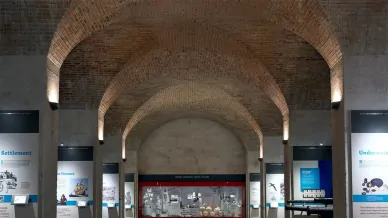
Interier of NMB
The connection between the Azores islands and Bermuda
Bermuda is known to be a historic landmark for Portuguese sailors, who were setting off to explore the world from the archipelago or the Azores. Making stops in Bermuda during long journeys was convenient and quite frequent, which contributed to the formation of the Portuguese community on its territory.
Since the 1800s, the connection between Bermuda and the Azores has become stronger. Nowadays, more than a quarter of the population of Bermuda is originally Portuguese. On that account, the NMB presents exhibitions that identify the common history and development of the culture of these islands.
Banknotes of Bermuda
The banknotes that Bermuda residents have in daily use since 1914 are a real masterpiece, as there are icons, and objects of local folklore depicted on them. NMB demonstrates the history of creation and production of banknotes, as well as illustrations showing the transition from pounds sterling to dollars.
Bermuda & the West Indies
Bermuda and the West Indies are connected with a centuries-old history of trade, piracy, slavery, exploits of the sea, and shipwrecks. The National Museum offers exhibitions dedicated to the hurricanes and tsunamis that occurred in the area between Bermuda and the West Indies, and their economic, cultural and social relationships.
Hall of history
The History Hall is a huge mural created by local artist Graham Foster, which portrays the entire 500 years of a long history. This amazing piece of art takes the visitor ́s breath away.
The Museum Playground & Playhouse
The Museum Playground & Playhouse is a project of the National Museum specially created for children. The playground along with the house are made according to the historical architectural monuments, which include a sandpit, the 21-foot lighthouse wrapped around by the legendary 70 feet long green moray.
This interactive exhibition was designed by local artists Russell Demure and James Cooper, and for their unique idea, the project was awarded by the Danish design company Monstrum.
Collection features
The National Museum of Bermuda offers more than 75 thousand exhibits. All of them were made from different types of material, and represent different stages of history. The collection includes real historical documents, photographs, nautical maps, and gun samples, or in other words the objects of activity of
Bermuda residents over the past 500 years. Besides, the building of the museum is also an actual architectural monument.
Majolica Plato
A kind of pottery which is called majolica is represented by a majolica blue plate that appeared in the NMB after the exploration of the San Pedro ship. This ship sank in 1596 near Bermuda. The following research after the ship exploration has revealed that the plate was made around the 1570s.
Map of Bermuda, c. 1630, By Johannes De Laet
The Map of Bermuda is considered to be a rare naval map, which illustrates the northeastern coast of America with Manhattan marked on it for the first time. The map was issued is 1630.
Bermuda sloop model, 2005, By Deryck Foster
The painting portrays a model of a Bermuda sloop that was widely used by the sailors in the 17th century on the islands. Due to many advantages such as being fast, light, and made of cedar planks, the sloops could have been used for a long time. The boats were widely used not only by traders, but also by privateers, and even pirates.
Golden Rule, 1849
This masterpiece was dedicated to the brigantine "The Golden Rule" in 1849 and depicts the scene of 58 emigrants from Madeira and other islands of Portugal arriving on the land of Bermuda. The transportation was initiated by Bermuda since additional labor was required for agricultural work.
Photograph of building the Dockyard extension, 1902
The photograph represents the work of West Indian immigrants, who were recruited to build the Royal Naval Dockyard. As the building process has been lasting for 5 years, 20% of the population of Bermuda were West Indians by 1901.
Bermuda Race trophy, 1909
This exhibit is an award received by Dr. Leedom Sharp, who won the 1906 amateur race on schooner Restless. To win the race the participant has to reach Bermuda from the US East Coast the first. The Ocean Race was organized by the journalist Thomas Fleming and held in 1906.
Current projects
The National Museum of Bermuda continuously develops by planning to implement several projects cooperating with companies and corporations.
Harnessing the power of solar
America’s Cap is a project which aimed at reducing negative influence on the environment by installing solar panels on the roofs of the museum building. They generate around 93.6 thousand kW per year, which reduces carbon dioxide emissions by 43 tons.
Warwick project
Together with the Institute of Marine Archeology NMB has researched English galleon "Warwick", which was found at the bottom of the ocean. The boat was studied carefully from 2008 to 2012, however, the analysis and expertise on it are still going on.
Casemates Restoration
Since 2005, NMB is looking for the support of volunteers, who are willing to contribute to the reconstructing the abandoned casemates. This project is evaluated as a large-scale, nevertheless, some essential works had been already completed such as garbage utilization, cleaning, and dismantling. The project foresees using the buildings for additional exhibit halls after the renovation.
Southampton Cottage
In 2014, the National Museum of Bermuda and the National Trust of Bermuda have discovered a wooden cottage construction on the territory of Bermuda from the 17th century. The scientists suppose that this founding was the first wooden building on the territory of the islands.
Homes for Long Tails
As a result of natural phenomena, the population of the Bermuda white-tailed tropical birds has significantly decreased and presently is under the risk. Due to the destruction of their natural habitats, birds have no place to settle. Therefore, NMB launched a project to build domes for bird nesting in 2009.
Since then, hundreds of volunteers are contributing to the project development by annually installing such domes on the tops of the cliffs. Besides, the bird rookery was built on the roof of the bastion with the purpose of bird preservation.
Bermuda underwater cultural heritage
The underwater heritage encompasses the remains of thousands of ships that after sinking remained forever at the bottom of the ocean. By conducting the archaeological excavations researchers can reveal secrets about the ancient culture of those years.
Why are shipwrecks so important?
A long time ago, before the airplanes were invented, ships were the only kind of transport capable of establishing a connection between Bermuda and other territories. Hence, the main activities that happened at that time usually involved ships. Archaeologists and historians detected many artifacts of the past times, after researching drowned ships.
Shipwrecks as time capsules
The time stops for the objects that were on the wrecked ship, and that is why such artifacts are immensely valuable for history. Archeologists can almost immediately find out the time of use of such objects. What is more, scientists are interested in the construction process of the ships of that time.
Theft of historical heritage and the law
Researchers often face a threat of losing the historical objects of shipwrecks because of the theft and their destruction by treasure hunters. By a single mistake, the artifacts of Bermuda can be lost forever.
Therefore, in 2001, the government of the island implemented a law that protects heritage objects, which states the following rules.
- Any item, which was found at the bottom of the ocean and seemed to have more than 50 years old belongs to Bermuda.
- Only individuals who have the appropriate permission from the government of Bermuda have the right to proceed with excavation and research.
- In the case of the law violation, the Department of Nature Protection should be contacted. (The official website of the NMB provides their contact information).
In case of finding some artifacts
As a result of storms and other acts of nature oftentimes artifacts are brought from the bottom of the ocean into the sea shore. To regulate the procedure in case of finding a historical object a special guide has been created.
- Leave the object on its place and do not touch it.
- Take a picture or record on a short video of the approximate location and appearance of the object.
- If you have a navigator, determine the exact coordinates of the location of the object.
- Immediately contact museum or the security service.
Go out and explore
Government of Bermuda allows the citizens to explore drowned ships on their own, however, this applies only for the ship that has been recognized as the safe ones. The other ships cannot be visited by average people. While exploring the ship, the investigators should keep in mind that it is strictly prohibited to touch anything, nevertheless taking pictures and making videos are allowed. For those who do not have an opportunity to have a tour on the drowned ship underwater, the museum will show gripping exhibits and artifacts from the bottom of the ocean.
Land archeology
The NMB is carrying out a project of land archeology in Bermuda by cooperating with foreign scientific universities. Archaeologists tend to find many objectives in the ground, which may seem to be useless. However, these types of historical rubbish are especially valuable for scientists, as these objectives can reveal information about the antecedent human activities as well as the state of the landscape and soil during many historical periods.
The space of the Museum
The spacious area of the museum is a perfect fit for organizing some public events. Therefore, the management of NMB decided to give some of the rooms for rent.
Commissioner's House
Cast-iron residence, or in other words the House of the Commissioner is a nice location for birthdays, weddings, and other private events. Guests will have a magnificent view of the ocean and the Royal Naval Dockyard. Besides, the building is designed in the Gregorian style, which is capable of holding events for 150 people in a luxury place.
The flagpole
A flagpole with cannons from the wartime is located right on the backyard of the Commissioner's House. From this point, there is a gorgeous view of the ocean, which makes this location an ideal venue for an open wedding ceremony.
Queen's Exhibition Hall / 1850 Ordnance House
The Queen's Exhibition Hall used to be a former ammunition depot that can fit in around 4,000 barrels of gunpowder. Currently, this hall with high ceilings and full of many interesting exhibits serves as a venue for banquets, and cocktail parties.
The Keep Yar
The castle`s yard, which area is 210 feet by 100 feet is surrounded by interesting architectural objects and is covered with a soft grass carpet. Besides, the place is decorated with tropical plants. The Keep Yar is an ideal location to hold outdoor events such as festivals, and fairs with the capacity of up to 2000 people.
The Boat Loft
A Boat Loft is for those who are into shipbuilding, sailing, and antiquity. This spot can be used to host lunches and dinners, get acquainted with the collection of rare swimming facilities in Bermuda.
The Keep Pond Terrace
Another worth visiting place is the terrace located on the high level of the building can be a great choice for taking a walk or having a cocktail party. The terrace has an amazing view of the artificial fjord that was used previously to transport ammunition. Currently, the fjord has become a local landmark.
A company called Museum Services Limited is responsible for the management of the rental on the territory of NMB. The monitoring process of the events is being conducted by employees to make sure that the guests are following the rules. Besides, the employees assist guests during events.
Management of the museum
The NMB is managed by a Board of Trustees. Rhys Fletcher is the Chairman of the Board, and his deputy is Michael Maguire. Matt Claridge is the Treasurer and James Watlington is Secretary. The following list includes the trustees of the company:
- Robert Blee;
- Jazmin Da Ponte;
- Dr. Douglas De Couto;
- Andrew Dias;
- Jennifer Davidson;
- Tim Davidson;
- Dr. Kim Dismont Robinson;
- Dr. Janet Ferguson;
- Pamela Ferreira;
- Michael Grayston;
- James Hallett;
- Dr. Clarence Maxwell;
- Isabelle Ramsay-Brackstone;
- Ru-Zelda Severin;
- Robert Steinhoff;
- Neil Stempel;
- Charles Thresh;
- Col. Sumner Waters.
Visiting the museum
The entrance ticket of the museum for children under 16 years old is free of charge, however, they have to be accompanied by an adult. During organizing school trips, there should be at least one adult per group of 10 children.
Planning a visit
Entrance tickets can be purchased on the website in advance. In case of planning a group excursion, the following information has to be provided:
- Date and time of visit;
- Name, number of the educational institution;
- The number of children and adults.
Furthermore, the museum staff has to be informed forehead in case of the presence of people with disabilities in the group, etc.
Services and access
The museum management is trying to do their best to ensure the guest are having the most pleasant experience possible during visiting the museum. For this purpose, the territory of the museum is provided with many features:
- elevators for visitors with disabilities;
- comfortable toilets free of charge;
- baby changing tables;
- restaurant based on the Dolphin Quest hotel;
- convenient benches on the outdoor area;
- free parking, easy access to the museum building by car;
- photography and video filming are allowed on the territory of the museum.
Hours and ticket price
The museum is open during the week from 9:00 a.m. to 5:00 p.m., and on weekends from 9:30 a.m. to 5:00 p.m. In February locals have an opportunity to visit the NMB for free, while on other days the ticket costs $15, for guests aged over 65 is $12.
Contacts
Address: The Keep, Sandys MA 01, Bermuda
To reach NMB employees users can see the contact information on the official website of the museum.
There a user can leave a request for a visit, indicating their name, surname, number of visitors, date, and email.
In case of having more questions contact the museum by email - info@museumservices.bm or by phone - +1 (441) 705 3061.
You can view ongoing exhibitions, events, or get additional information in the communities in social networks by following the links:
- Facebook - https://www.facebook.com/natmuseumbda/;
- Twitter - https://twitter.com/NatlMuseumBDA;
- Instagram - https://www.instagram.com/nationalmuseumbermuda/.